How to Choose the Right Car Lift for Your Home Garage
When homeowners start thinking about maximizing their garage space, the options can feel overwhelming. Underground car elevators, scissor lifts, 2-post parking lifts — each solves a different problem in a different way. So how do you figure out which one is right for your home? This guide breaks it down by the factors that matter most: space, budget, ceiling height, and long-term goals.
Start With Your Space
The first thing to assess is what you're working with. A standard attached garage in Canada typically offers between 18 and 22 feet of depth and a ceiling height of 8 to 9 feet. Some custom-built or detached garages go higher. Why does this matter? Because your ceiling height is often the deciding factor in which type of lift is even feasible.
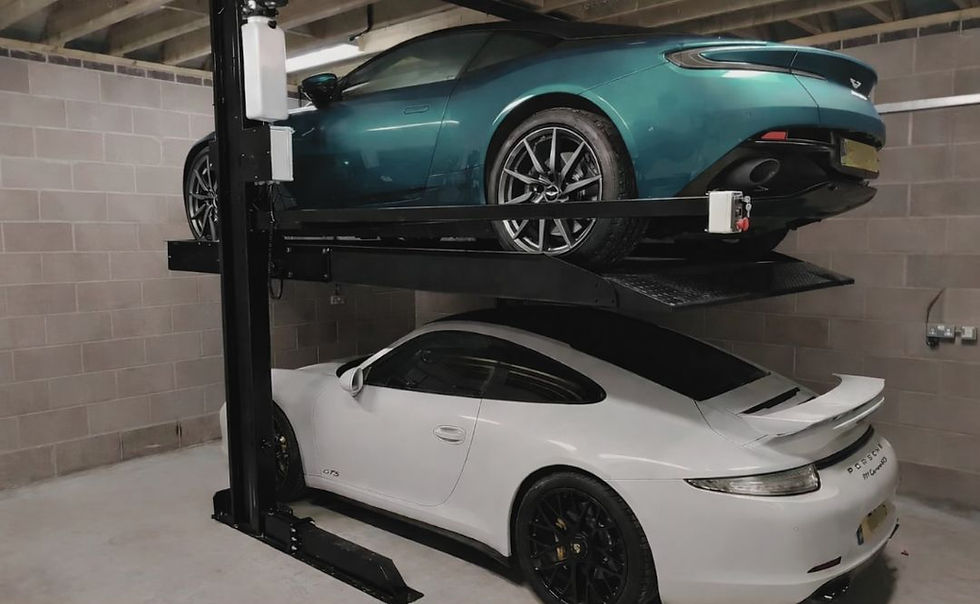
A 2-post parking lift typically requires a minimum ceiling height of around 131 inches (approximately 3.3 meters) to safely raise one vehicle above another with adequate clearance. If your garage doesn't meet that threshold, a 2-post system won't work without modification. An underground car elevator, by contrast, requires no ceiling clearance at all — instead, it needs below-grade depth, which is incorporated during construction or through a retrofit excavation.
Think About What Problem You're Actually Solving
Before choosing a lift, be clear on what you need it to do. Are you trying to park two vehicles where you currently only fit one? Do you want hidden, secure storage for a collector car? Are you building a new home and want to future-proof the garage? Each scenario points to a different solution.
For straightforward double-parking in an existing garage, a 2-post parking lift is often the most practical and cost-effective choice. For luxury builds, urban infill homes, or projects where aesthetics and property value are priorities, an underground car elevator offers something no above-grade system can: complete invisibility when not in use.
Consider the Installation Process
Installation complexity varies significantly between lift types. A 2-post parking lift can typically be installed in a day or two, provided your concrete slab is adequately thick (usually 4–6 inches) and your electrical supply meets the requirements. It's a relatively low-disruption process.
Underground car elevators involve more planning. They require a reinforced pit, civil engineering, waterproofing, drainage, and hydraulic infrastructure. For new construction, these elements can be seamlessly integrated into the design. For retrofits, it's a more involved project — but one that many homeowners find worthwhile given the long-term benefits.
Budget Realistically
The cost difference between a 2-post lift and an underground car elevator is significant. A residential parking lift is a fraction of the cost of a custom underground system. That said, the return on investment works differently too. In markets like Toronto, Vancouver, Montreal and Calgary, adding a concealed parking solution to a property can meaningfully increase its resale value and marketability.
Think of a 2-post lift as a practical upgrade, and an underground car elevator as a premium architectural feature. Both are investments — the right one depends on your priorities.
What's Your Long-Term Vision?
Finally, consider where you're headed. If you're planning to live in your home for many years, the added cost of a premium solution may pay dividends in both daily enjoyment and eventual sale price. If you're looking for a quick, functional fix, a parking lift gets the job done efficiently.
At Nelca Systems, we work with homeowners across Canada to find the right solution for their specific situation. Whether you're exploring a scissor lift platform for a new build or a 2-post lift for your current garage, we offer free consultations and custom quotes. Reach out today to get started.


Comments